


Profit on paper does not pay salaries, rent, or suppliers. Cash does. Many UAE businesses are profitable and still struggle because money arrives late and bills arrive early. The right cash flow management strategies help you avoid that gap, stay in control, and plan growth with confidence.
At Al Watanyah, we work with business owners across the UAE every day. This guide covers the practical steps that actually keep a business stable, in plain language.
Why Cash Flow Matters So Much in the UAE
The UAE market moves fast. Customers expect quick service, suppliers expect quick payment, and costs like office rent, visas, and licence renewals come on fixed dates.
Here are some common pressure points for local businesses:
- Extended customer payment periods, often 60 to 90 days
- Post-dated cheques that delay actual cash
- Fluctuations in sales throughout different seasons, like summer declines
- Yearly or quarterly rent payments
- VAT and corporate tax obligations
If you do not plan for these, even a strong business can run short of cash. The UAE Ministry of Economy regularly highlights the importance of sound business practices for sustainable growth, and cash discipline is at the heart of that.
Build a Reliable Cash Flow Forecast
A cash flow forecast is a simple projection of the money coming in and going out over the next few weeks or months. It shows you problems before they happen.
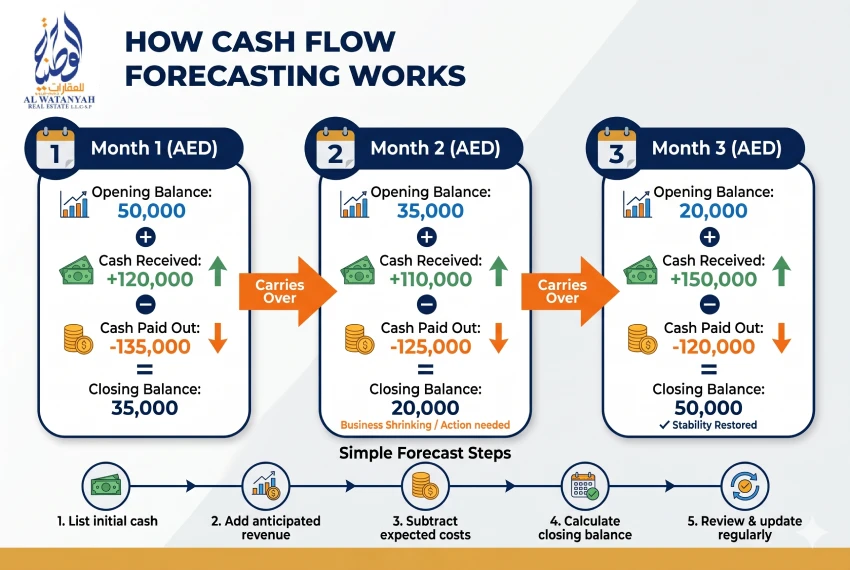
How to Create a Simple Forecast
- List your initial cash balance.
- Include anticipated revenue, along with feasible payment dates, rather than invoice dates.
- Subtract all expected costs: rent, salaries, supplier bills, VAT, loan payments.
- Calculate the closing balance for each week or month.
- Review and update it regularly.
Here is a basic example:
| Item | Month 1 (AED) | Month 2 (AED) | Month 3 (AED) |
| Opening balance | 50,000 | 35,000 | 20,000 |
| Cash received | 120,000 | 110,000 | 150,000 |
| Cash paid out | 135,000 | 125,000 | 120,000 |
| Closing balance | 35,000 | 20,000 | 50,000 |
In this example, the business is shrinking its cash for two months. With a forecast, the owner can spot this early and act, instead of being surprised in month three.
A good rule is to forecast at least 13 weeks ahead and update it every week or two.
Speed Up Your Receivables
Late payments are the biggest cash flow killer for small and medium businesses. The good news is that you can improve this with a few simple habits.
- Invoice immediately. Send the invoice as soon as the work is done or the goods are delivered.
- Set clear payment terms. Make the payment deadline easy to find, both on your invoices and in your signed agreements.
- Offer small early payment discounts. A 2% reduction for payment within 10 days can speed things up.
- Follow up politely and consistently. An alert before the deadline and another right after works well.
- Check customers before extending credit. Review their payment history and reputation.
- Track post-dated cheques. Maintain an organized calendar of cheque dates to avoid any unexpected issues.
Minor adjustments in this area frequently release funds more quickly than any other action.
Strengthen Working Capital Management in UAE
Working capital management in UAE businesses means balancing your short-term assets (cash, receivables, stock) against short-term liabilities (supplier bills, short-term loans, payroll). The aim is simple: consistently maintain sufficient liquid assets to manage daily activities.
Key Working Capital Ratios
| Measure | What It Tells You | Healthy Sign |
| Current ratio | Ability to cover short-term bills | Above 1.2 to 1.5 |
| Days sales outstanding | How fast customers pay | Lower is better |
| Days payable outstanding | How long you take to pay suppliers | Balanced with your own collections |
| Inventory turnover | How fast stock sells | Higher is better |
Practical Ways to Improve It
- Negotiate extended payment terms with suppliers, maintaining good relationships.
- Avoid overstocking. Excess inventory locks up cash.
- Match payment dates to your collection dates where possible.
- Review your working capital position monthly, not yearly.
Strong working capital gives you room to handle surprises, take advantage of new opportunities, and avoid expensive emergency borrowing.
Control Your Expenses Without Hurting Growth
Reducing expenses doesn’t imply reducing quality. It signifies spending wisely.
- Separate fixed and variable costs. Understand what is unchangeable and what is within your control.
- Review subscriptions and contracts. Many companies spend money on tools or services that they hardly utilize.
- Compare supplier quotes yearly. Even minor savings accumulate.
- Plan for tax payments. Set aside money for VAT and corporate tax each month so payment dates do not hit hard.
- Delay non-essential purchases. Wait until cash is stable before buying equipment or upgrading offices.
A simple monthly expense review can uncover savings you did not know existed.

Build a Cash Reserve and Plan Your Financing
Every business needs protection. A common guideline is to maintain three to six months of operating expenses in reserve. If that feels too big, start small and build gradually, even 5% of monthly revenue.
For financing, think ahead:
- Arrange a business credit line before you need it. Banks are more flexible when your finances look healthy.
- Avoid using short-term loans for long-term needs.
- Maintain personal and business finances separate.
- Compare the real cost of borrowing, including fees and interest.
Planning your financing early keeps you in a position of strength, not desperation.
Use Professional Support and Good Systems
Managing cash well takes time, accuracy, and consistency. Many UAE business owners prefer to hand this over to experts so they can focus on running the business.
Good bookkeeping, accurate monthly reports, and timely VAT and tax filing are the foundation of every healthy cash position. Professional financial and accounting services can help you set up forecasting, track receivables, manage compliance, and give you a clear picture of where your money stands.
Useful systems to adopt:
- Cloud accounting software for real-time visibility
- Automated invoice reminders
- Monthly management reports
- A weekly cash review habit
Conclusion
Stable finances do not happen by luck. They come from consistent habits: forecasting, collecting faster, managing working capital, controlling costs, and keeping a reserve. Applying these cash flow management strategies step by step will help your UAE business stay steady in good months and strong in difficult ones.
Start with one action this week, such as creating a simple forecast or tightening your invoicing. If you want expert help, the team at Al Watanyah is ready to support you with reliable financial and accounting guidance.
Frequently Asked Questions
1. What are the best cash flow management strategies for small businesses in the UAE?
The most efficient ones are creating a regular cash flow forecast, invoicing quickly, following up on late payments, controlling expenses, and keeping a cash reserve. Doing these consistently makes a big difference.
2. How often should I update my cash flow forecast?
Update it weekly or at least every two weeks. In fast-changing periods, such as seasonal slowdowns, review it even more often.
3. What is working capital management in UAE businesses?
It is the process of balancing short-term assets like cash, receivables, and stock against short-term liabilities like supplier bills and payroll, so you can always run daily operations smoothly.
4. How much cash reserve should a UAE business keep?
A common guideline is three to six months of operating expenses. If that is not possible right away, build it gradually from monthly revenue.
5. When should I get professional help with cash flow?
Consider it when payments are regularly late, you are unsure about your real cash position, or tax and VAT filings feel stressful. Professional financial and accounting support can bring clarity and save time.